Thank you Alan Bram
This gem we call the Jewish Community Campus has served our community well since its opening in 1988. Since the creation of the Campus we have had the good fortune to have a premier facility manager in Alan Bram. I was fortunate to work with Alan when he came on board as he was initially officed at the Jewish Federation when it was located downtown. It was immediately clear to me that the Campus leaders back in the late ’80s recognized an extremely talented facilities’ manager when they met Alan. Their prescient decision to hire Alan has resulted in 24-plus years of real devotion to keeping the Campus as our community’s gem. Many of you probably aren’t aware that over the years Alan has been a consultant to other facilities around the country. His knowledge and expertise of how to run a complex and multi-purpose facility is rare. Alan’s dedication and commitment to keeping the Campus in such great shape has allowed our community members to work and play in a safe and well-kept environment. His selection of accommodating and knowledgeable staff has made the Campus the envy of all who visit here. Alan Bram is retiring and although he may not be physically present with us going forward as the Campus director, his influence and tender loving care of our community home will never be forgotten and for that we owe him much gratitude, appreciation and our collective thanks.
Shari Stimetz
Gladstone, Mo.
Scouting evolves, values persist
Recently, The Chronicle covered the decision of the Boy Scouts of America (BSA) to change its membership policies to no longer exclude gay youth. This is a long-awaited step in the right direction, which should be seen as evolutionary rather than revolutionary.
Many of us in the Jewish community actively participate in Scouting because it is a program proven to succeed in its mission to instill in youth character, citizenship and fitness. An independent (not commissioned by BSA) study from Baylor University*, utilizing the Gallup poll’s methodology, was released early this year entitled “Merit Beyond the Badge.” The Baylor study revealed that Eagle Scouts exceed societal norms in areas such as participation in health and recreational activities, connectedness to their families and community, community service activities, protecting the environment, planning and preparedness, goal orientation and respect for diversity, among others.
The National Jewish Committee on Scouting voted earlier this spring to support a resolution to allow the chartered organizations (sponsoring institutions of cub packs and scout troops) to determine their own membership and leadership standards to reflect the values of the chartered organization for their youth programming. That resolution did not make it to a final vote at the national BSA meeting this May. The resolution that was voted on by more than 1,300 Scouting volunteer delegates from throughout the country passed by a 61 percent to 39 percent margin, repealing the ban on gay scouts, but not on gay adults serving in a leadership role.
It took 13 years for Scouting to evolve from the Supreme Court decision supporting BSA’s right, as a private institution, to create its own membership and leadership standards, even if such standards were discriminatory. How long will it take BSA to evolve to the next step of inclusiveness among leaders, as well as youth, remains to be seen.
Scouting’s success for over a century in leadership and character development in our nation’s youth is hard to match. Today more than 2.7 Million youth participate in the Scouting program, while locally more than 35,000 youth are in the Scouting program. Scouting has and will continue to change as societal norms evolve. Meanwhile, many of us who are active in Scouting will continue to work from the inside for evolutionary change, trying to be patient and persistent as we continue to provide a proven program for today’s youth to achieve the values that their families and communities recognize in leaders.
*Jang SJ, Johnson BR, Kim Y, “Eagle Scouts: Merit Beyond the Badge”, Baylor University, 2013.
Norman Kahn, Member, National Jewish Committee on Scouting; Chair, Central Region Jewish Committee on Scouting; Former Chair, Heart of America Council Jewish Committee on Scouting
Joyful conversion process
I’ve always believed that when something is in our destiny, we just have to wait until it comes and then we must work hard to make that dream come true. That’s exactly what happened to me recently during my conversion process.
It was during Chanukah in 2012 that I met a Jewish Argentinian man who would help me more than anyone during the process. He also introduced me to Rabbi Jacques Cukierkorn.
I still remember when I met Rabbi Cukierkorn. He was sympathetic, kind, reliable and pleasant. I chose him as my teacher.
After that came a series of long emails, where Rabbi Cukierkorn was always willing to help me. After a little less than a year, the rabbi told me I was ready for my conversion and he would come to Mexico for the ceremony. But I told him I wanted to travel to Kansas instead.
I flew for Kansas City on the 29th of Nisan. My conversion took place the next day. I was very nervous. Once inside Kehilath Israel Synagogue where the mikvah is located, we went inside the library to meet the members of the Beit Din — Rabbi Cukierkorn, Rabbi Paul Silbersher and Rabbi Scott White.
They asked me about many things I had studied with Rabbi Cukierkorn. After about an hour, I went to the mikvah.
Since the very first moment I entered the mikvah, I started to experience a very unique sensation. It was a mixture of euphoria and calmness. Everything was different. I felt joyful. It is something unexplainable with words. It was so beautiful and I’ll never forget it.
Following the mikvah, we headed toward the shul. There Rabbi Cukierkorn let me hold the Torah and Rabbi Silbersher started to sing. I must confess I’ve never heard a man sing with such intensity and so beautifully. I just can’t stop talking about the wonderful feeling it all provoked in me. I was finally converted!
The day wasn’t over yet. Rabbi Cukierkorn showed me around the Jewish Community Campus, we attended the Yom HaShoah service, he introduced me to his beautiful family and he gave me a few gifts in honor of my conversion.
The day of my conversion was only the second time in my life I saw Rabbi Cukierkorn. When I saw him that day, I felt as if I had known him for a long time. I will never forget his kindness and hospitality. Thank you rabbi!
Stephanie Ruiz Lack
Puebla, México



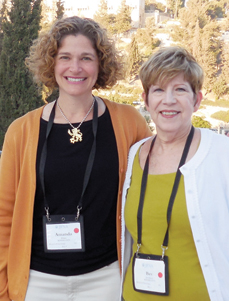 For a week in July, Bev Jacobson and I had the amazing privilege to go on the Jewish Federations of North America (JFNA) Campaign Chairs mission to Belarus and Israel. This was not your regular mission to tourist sites and famous landmarks. Instead we learned the history of Jewish communities in the former Soviet Union, met Holocaust survivors, delivered care packages to elderly Jews in need and danced with Jewish kids of all ages at the JDC community center in Minsk, Jewish summer camps in Belarus, and then Birthright Israel participants and IDF soldiers in Israel.
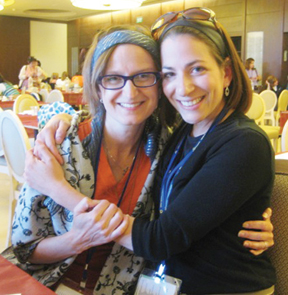 What do you get when you take 14 women from diverse Jewish backgrounds, many of whom do not know each other, and send them on a 10-day trip to Israel together? An entirely new perspective and an amazing sisterhood!
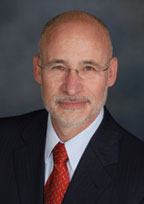 Leslie and I were recently reviewing our personal legal documents — wills, powers of attorney, health care directives, etc. A friend asked us a question, “Do your children have their own ‘durable power of attorney for health care decisions’ documents?