


Invisible people: We have the power to make them visible
 As we are reflecting during this domestic abuse awareness month, we can think about all types of victims and invisible people in our society today.
Having moved between countries and cities throughout my childhood, I recall often standing alone at recess feeling as if I was invisible. In a very small way, I feel like I can relate to the hundreds of people feeling the powerlessness of invisibility in a society that does not see them.
Far beyond the social awkwardness of the playground, there are invisible people everywhere who are victims of deep injustices and oppression. They are the boys who wash our dishes at restaurants and the men who wash our cars. They are the girls who make our hotel beds and the women who serve in our homes. They are the slaves confined by our penal code and the objectified defined by our sexual appetites. They are the homeless who spend their days in our shadow and their nights in our parks. They are the abused who cry but are not heard.
While “underclass” invisibility is caused initially by systems of oppression, shame invariably leads these vulnerable individuals to perpetuate this depressed psychological and social state. “Shame involves the realization that one is weak and inadequate in some ways in which one expects oneself to be adequate. Its reflex is to hide from the eyes of those who will see one’s deficiency, to cover it up,” explains legal scholar Martha Nussbaum.
One who lacks basic needs often wishes not to be seen for fear of shame. This is made worse by our shame at seeing them and not taking action, and the further clouding of visibility that follows. As Nelson Mandela rose to become the first democratically elected state president of South Africa, a country shamed by a history of painful injustice, he shared that, “As we are liberated from our own fear, our presence automatically liberates others.” We need the courage to see and make seen the victims of injustice among us.
We have been granted the power to help make visible the invisible. We accomplish this by letting the vulnerable hiding in the shadows know every time we encounter them that they are recognized members of society, members in good standing even, and especially by letting the public know they exist by advocating for their rights and welfare.
Jewish law even demands not only that we see but that we be seen (“yireh, yai’raeh”) in Jerusalem on the festivals (Chagigah 2a). This is training for the rest of the year that our eyes, and hearts, be open to see those who are unseen. Connecting and supporting the unseen is not a distraction from the tradition but its actualization.
One of the primary goals of Jewish spiritual life is to see beyond the physical, to sanctify the unseen and to elevate matter to a higher plane. The Maggid of Mezritch, the great Chassidic master, helped to introduce us to the idea of “yesh me’ayin” — creation out of nothing — to mean that in helping something come into existence that previously did not exist, or helping something be seen that previously was unseen, it is like we are emulating the very creation of the universe.
Greater than lending money or giving tzedakah to a poor individual, the rabbis tell us, is providing partnership (Shabbat 63a). Our charge is to join the invisible in solidarity and partnership: Let us help make their voices heard and their humanity seen.
Some of the most terrifying times in my own life have been when I didn’t really feel like I existed; in these moments, I didn’t feel acknowledged by the world, let alone appreciated or loved.
I have been fortunate to have the support to get through those times. I would venture to say I am not alone in having had these feelings, neither am I alone in recognizing the crucial role played by friends and family members to remind me of my visibility and humanity. Let us be those friends, let us be those family members, and let us be those advocates for those who have none. May we be blessed with the good sight to see the unseen, and the vision to increase their visibility in our blessed nation.
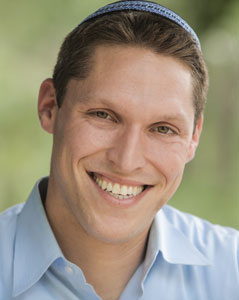
Rabbi Shmuly Yanklowitz is the senior rabbi at Kehilath Israel Synagogue, the founder and president of Uri L’Tzedek, and is the author of “Jewish Ethics & Social Justice: A Guide for the 21st Century.” Newsweek named Rav Shmuly one of the top 50 rabbis in America earlier this year.
 QUESTION: I am a member of a local Orthodox congregation here in Kansas City. My son is marrying a modern Orthodox girl in a large East Coast city. The wedding will take place in a Spanish Portuguese synagogue of which her family has been a member for generations. My son has been told by the rabbi that it is not their tradition for the bride to walk around the groom. Furthermore, my son was told he cannot wear a kittel or the white gown that many Orthodox grooms wear when they are married. Are not these laws in Judaism or are they just tradition?
 It isn’t often that one gets to see the manuscript of a well-known political figure before it is published, so I was flattered when a good acquaintance asked in June if I would look over an edited manuscript of a Member of Knesset, who needed it in two days. I readily agreed.
 Barbara Bayer recently wrote about a newly released book called “Am I a Jew?” by Theodore Ross. (Oct. 4)
 A Jewish Holocaust survivor is haunted by memories of the Polish lover that risked his life to save her. The romantic war drama “Remembrance” directed by Anna Justice is the opening night film of the 14th Annual Kansas City Jewish Film Festival.
 The community is buzzing about a newly published book, “Am I a Jew?” written by Theodore Ross, an author from New York. It’s been out a month or so already. I wasn’t terribly interested in it, and it just sat on my desk waiting to be given to one of our book reviewers. However out of the blue, just before Yom Kippur, I got some phone calls about it. Then I was intrigued.
 For someone like me, who spent most of his career in the business community, working at Jewish Family Services for the last five years has been a real eye-opener. I knew there were people living in poverty in our community, but I never got close enough to those in need to really understand their stories. But at JFS, as I talk with our social workers and clients, I have learned just how basic some of those needs are.