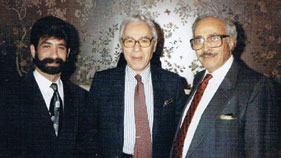
 My uncle, Rabbi Stanley Rabinowitz, who for 26 years guided Washington, D.C.’s largest and oldest conservative synagogue, passed away on Friday, June 8. It was his 95th birthday.
During his nearly three decades as the spiritual leader of Adas Israel Congregation, guests in his synagogue included presidents, Israeli prime ministers, Supreme Court justices, countless members of Congress, government officials and journalists.
Most of Israel’s ambassadors attended his services, as did Prime Ministers Golda Meir and Yitzhak Rabin. Rabin and Ambassador Simcha Dinitz celebrated their sons’ Bar Mitzvahs at Adas Israel with Rabbi Rabinowitz.
His obituary was in the Washington Post, the New York Times, The Forward, Israeli newspapers and carried by the Jewish Telegraphic Agency. So I was quite surprised not to see a mention of the death of this prominent man of the Jewish world in The Chronicle.
Perhaps his most notable accomplishment, Rabbi Rabinowitz served two terms as president of the Rabbinical Assembly, the international organization of Conservative rabbis.
He was especially concerned with Zionism and Israel, and their relation to Conservative Jewry.
Together with representatives of the Reform movement, in 1977 he successfully negotiated with Israel’s then-Prime Minister Menachem Begin, the indefinite postponement of a bill to change Israel’s Law of Return and Israeli definition of Jewish identity. The projected changes, if adopted, would have compromised the role of Conservative and Reform rabbis and challenged the status of their converts. The changes were not implemented.
As RA president, he traveled to Egypt to meet with religious and political leaders. He was a guest in Anwar Sadat’s home.
President Carter subsequently invited Rabbi Rabinowitz to deliver the invocation prayer at a service at The Lincoln Memorial celebrating the signing of the peace treaty between Israel and Egypt. He attended the signing itself, and then dined on the White House lawn with the dignitaries at a large formal kosher dinner.
Rabbi Rabinowitz led his congregation and Washington’s Jewry through much of the turbulent times of race relations in the ‘60s. The Rev. Dr. Martin Luther King spoke at a city meeting my uncle hosted in 1963.
In 1964, immediately after the assassination of President Kennedy, Rabbi Rabinowitz was invited to give the sermon at Mount Vernon Place Baptist Church, which was attended by President and Lady Bird Johnson. Upon returning home, my uncle received a personal call from the first lady asking him for a copy of his speech. That night, in his televised Thanksgiving address to the nation, President Johnson included the theme of my uncle’s sermon, and quoted from it.
He danced with Betty Ford at the White House, and received a personal letter from President Reagan upon his retirement.
Rabbi Stanley Rabinowitz was born in Duluth, Minn., and raised in Des Moines, Iowa. He was the son of Jacob and Rose Zeichik Rabinovitz. He was the oldest of three sons including my father, the late Ronald Rabinovitz. He was the grandson of Rabbi Naphtali Hertz Zeichik, noted Talmudic scholar and “Chief Rabbi of Iowa,” and the nephew of Faye Zeichik Schenk, international president of Hadassah and president of the World Zionist Organization.
He was a graduate of the University of Iowa, Yale University and the Jewish Theological Seminary. He was an honorary fellow of the Hebrew University in Jerusalem. He was predeceased by his wife Anita (Lifson) in 2008, his son Nathaniel in 2007 and his brother Ronald (my father) in 2006. He is survived by two daughters, four grandchildren, a great grandson, a brother and many nieces and nephews (including myself).
In 1947, one of his earliest professional duties as a rabbi was officiating at the marriage of my parents in Monterrey, Mexico, my mother’s hometown. The ceremony was in Yiddish, Hebrew, Spanish and English.
In his younger days, Rabbi Rabinowitz was one of the original founders of AZA (Kansas City, Omaha and Lincoln, Neb., and Des Moines were the first four chapters in the country), and served as one of the earliest international presidents. Rabbi Rabinowitz was vice chairman of the B’nai B’rith Youth Commission and chairman of its Judaica publishing committee, which published a series of pamphlets for young people, many of which he authored. He was also chairman of the editorial board of the National Jewish Monthly. While he was president of the Rabbinical Association, he helped edit the new Haggadah issued by the Conservative movement. It is still in wide use today.
Rabbi Rabinowitz was very active in Jewish community affairs as well. He served as Chairman of the Rabbinic Cabinets of UJA and of AIPAC. He was the also the founding president of Mercaz, the Movement for the Reaffirmation of Conservative Judaism.
He was a scholar, a historian a profound thinker and an author. He was a powerful rabbi, poised and polished. He was eloquent and elegant. Our family was always so proud. But despite the many accomplishments of this great man, to me and all the cousins from Des Moines he was still just our Uncle Stanley.
David Rabinovitz moved to Kansas City in 1978 to serve as youth director of the Jewish Community Center. He co-owned Metropolis Restaurant from 1989 until 2003 and now manages Chaz, the restaurant at the Raphael Hotel.



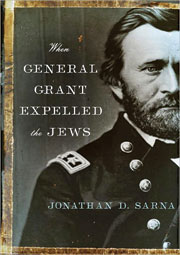 There were probably no more than 150,000 Jews in the United States at the time of the Civil War. Many of them served in the armies of both the North and the South. Then, on Dec. 17, 1862, General Ulysses S. Grant issued an infamous order that expelled the Jews “as a class” from the territories over which he had military control. The supposed reason for the order was to eliminate smuggling and profiteering, which Grant, at the time, attributed to Jewish merchants. In fact one family involved in profiteering was the Macks, Jewish clothing manufacturers. The Macks were Jewish, and their partner was none other than General Grant’s father, Jesse.
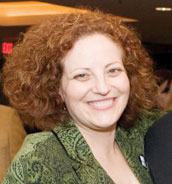 For more than 200 years the Missouri Constitution has protected the religious liberty of all Missourians whether in the majority or minority. It already provides all Missourians with the right to privately and voluntarily prayer in public schools, workplaces and other government settings. But in 2011 our legislature recklessly decided to play with these fundamental rights by passing Constitutional Amendment 2 which will appear on the Aug. 7 ballot innocuously called “Freedom to Pray in Public Places.” This misguided amendment should be rejected. It would undermine religious freedom by putting government in the business of religion and allowing majority faiths to impose their religious beliefs on the minority.
 “Tangles: A Story about Alzheimer’s, My Mother and Me,” by Sarah Leavitt. (Skyhorse Publishing 2012)
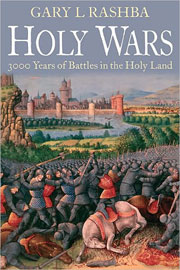 I recently heard a speech given by author Gary Rashba about the book he wrote about 3,000 years of Israel’s wars, “Holy Wars.” It was sponsored by Media Central, an independent media-liaison organization and support service for foreign journalists.